


At this moment, 12 years ago, the world changed .....
Showing posts with label Anniversary. Show all posts
Showing posts with label Anniversary. Show all posts
Wednesday, September 11, 2013
Thursday, July 11, 2013
 |
Long ago ... okay, thirteen years ago .... in a state far, far away .... California .... I came across a man in an AOL chatroom. We began talking and joking and learning about one another. Four months later, July 11th, 2000, I flew from California to Ft Lauderdale and met the man who would change my life forever, and for the better. We spent over a week together, and then the next month he flew to California to see me, and four months later I moved to Miami. But this ride started thirteen years ago, today. Happy Anniversary Of The Day We Met In Person, Carlos. Whoosh, that's a mouthful. |
 |
From the Good News File: Texas Governor Not-Gay Rick Perry has announced that he will not seek reelection: “The time has come to pass on the mantle of leadership. Today, I’m announcing I will not seek reelection as governor of Texas.” The Bad News File: Perry will probably run for President in 2016. The Good News File: He’ll quit the race soon after. The Bad News File: The main contender to succeed Perry is virulently anti-gay Texas Attorney General Greg Abbott, who declared in April that any Texas municipality that offers domestic partners insurance to its employees is in violation of the state constitution. |
 |
So, I loves me some Daniel Craig. As James Bond; as anyone. Talk about oozing sex appeal. Talk about a delicious hot body. Talk about looking good in a blue square-cut. But then I read that Craig was starring in a film called Dream House which seemed like your standard ooh-scary-wannabe-horror film and I thought, “Why Danny, why?” Then I saw it and it was pretty good, with a nice little twist a la The Others. Another high pint? Though the film was directed by a man, there are many tight close-ups of Craig Rear Rend—though it’s sadly clothed. But there are plenty of shirtless Craig and plenty of tight T-shirt Craig. All in all, a win-win for this Daniel Craig obsessed |
 |
So, this week Pat Robertson—who never uttered a rational thought in his entire life—said he wishes Facebook had a 'Vomit Button' he could use when he sees photos of Gay Couples. This from a man who looks like a cartoon alien from the Flintstones? Really? |
 |
Paula Deen may do Dancing With The Stars. As if I needed another reason never to watch. Speaking of Deen, I am trying to create a new language based on celebrity misdeeds: Last night we went to dinner and our server was black, so I Paula Deen’d the manager. I got into a Twitter war yesterday and I Alec Baldwin’d the guy. I don’t know what the big deal is? I was sitting with someone in my car and I got Eddie Murphy’d. |
 |
| I have one request of the Tea Party: Spell-f&%$ing-check your signs before you head out of your trailers! |
 |
You go, ACLU! The ACLU has filed suit in Pennsylvania, Virginia, llanos and North Carolina, claiming their anti-marriage equality bans are against the law in light of the SCOTUS ruling on DOMA. The march is on ….. |
 |
Hot Man Alert! Steve Grand, former extremely hot underwear model has released a new song called 'All American Boy' which is the tale of one gay man's unrequieted--up to a point--love for his best friend. He can sing … and he’s openly gay! Hot. Gay. Sings. Hot. |
 |
A few months back it was announced Joy Behar was leaving The View. I was sad because I like Behar’s sense of humor and her politics. Then the rumor mills swirled that Barbara Walters would be retiring, and I thought, Yay! I mean, if I wanted to see a dotty old lady on TV, I’d NetFlix old episodes of Bewitched for the one with Aunt Clara. Amirite? Walters declared she wasn’t retiring and then a month, later announced her retirement. Then the story was that Republican Rightwingnut Elizabeth Hasselbeck was being ‘let go’ and again Walters said it wasn’t true, and that Hasselbeck was welcome there as long as she wanted. Which proved to be true this week when it was announced that Hasselbeck was called home to the Mother Ship, AKA FauxNews, for their sadly named Fox & Friends show. So, was Hasselbeck fired? Let go? Not renewed? Well, her last day on The View was the very day she made her announcement so it looks like the whole ‘letting go’ idea was right and that she was given time to find a new gig, or make a reasonable excuse as to why she was gone. That leaves Whoopi—Thank the goddess for Whoopi—and Sherri Shepard, whom I think of as The Urkel of The View. |
 |
The Mama Grizzly Bore™, AKA MGB™, is rumored to be considering a run for the Senate from Alaska. May I remind you, good people of Alaska, that when you elected her governor she quit halfway through? So, elect her to the Senate and you’ll have her for just three of the six years before she declares it too hard and walks away. Think twice, Alaska, think twice. |

Thursday, June 27, 2013
Originally posted June 27, 2009:


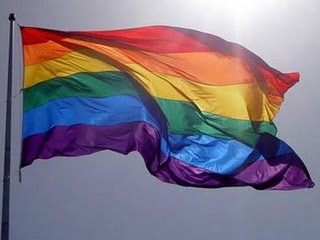
It was forty-one years ago, a lifetime to some of us, a minute to others, but it marked a turning point for the LGBT community. It marked one of the first, and definitely the loudest, times that gay men and women stood up en masse and said, No. We will not be treated like this any longer!
The weekend of June 27-29,1969 began what is the modern day gay movement. To be sure, there were gay and lesbian activists before that weekend, but the confrontation between police and demonstrators at the Stonewall Inn in New York lit a fire in the hearts of the LGBT community like it had never been done before.
The weekend of June 27-29,1969 began what is the modern day gay movement. To be sure, there were gay and lesbian activists before that weekend, but the confrontation between police and demonstrators at the Stonewall Inn in New York lit a fire in the hearts of the LGBT community like it had never been done before.
And like any good story, there is controversy surrounding the Stonewall Riots; there are arguments and differences over what happened, how it started and how it ended. But the fact we all need to remember is that it did happen, and it should continue to be a rallying cry for the LGBT community to be, finally, considered equal in the eyes of America.
It was Friday, June 27, 1969, and the world was mourning the death of Judy Garland. Could it be that the death of one of the most famous gay icons was what sparked the fire of the modern day Gay Rights Movement? Many people have speculated that Garland's death did indeed push the gay community into the streets of New York that night. But it was also hot, that night, and many say it was the heat that fueled the crowd into action, into reaction. Maybe it was both Garland's death and the hot summer night; or maybe it was just that the gay community had finally had enough of being told what to do, what not to do, and how we should live our lives. Whatever the reason, it was enough. Finally, enough.
In the early morning hours of June 28, police officers raided the Stonewall Inn, a small bar located on Christopher Street in Greenwich Village. Although mafia-run, the Stonewall, like other predominantly gay bars in the city, got raided by the police periodically.
Typically, the more "deviant" patrons--drag queens and butch lesbians, especially if they were black--were arrested and taken away, while white, male customers looked on or quietly disappeared. The bar owners would be levied an insubstantial fine--a sign of corruption and collusion between bar owners and police--allowing them to open for business the following day.
On this night, the charge at the Stonewall was the illegal sale of alcohol. The raid began as they always did: plainclothes and uniformed police officers entered the bar, arrested the employees, and began ejecting the customers one by one onto the street. For some reason, however, the crowd that had gathered outside the Stonewall, a somewhat campy and festive crowd, began to cheer as the patrons were pushed out of the Stonewall Inn. But soon the mood changed; it was Judy Garland's death, or the summer heat, or the fact that the summer of 1969 was a particularly busy one for police raids on gay bars. Or maybe it was watching drag queens and lesbians being pushed and shoved and kicked into paddy wagons.
Whatever it was, the on-lookers lost their patience. No one really knows who threw the first punch; some say it was a drag queen, some say it was a rather butch-looking lesbian. But someone defied the police that night; someone had finally had enough.
The crowd, now numbering several hundred, exploded. People began hurling coins at police officers, then they moved on to rocks and bottles, whatever they could grab. The police, at first stunned that the normally docile and shamed homosexuals would react in such a fashion, soon began beating the crowds with nightsticks. This group, however,was too angry, and could not be pushed down; the police officers were forced to take refuge inside the Stonewall.
As news spread throughout Greenwich Village the crowd grew ever larger; many residents, some gay, some not, ran down to the Stonewall Inn to join the fight. Lighter fluid was squirted inside the bar and someone tried to light it; others grabbed a downed parking meter and used it as a battering ram against the front of the Stonewall. Someone began chanting "Gay Power!"
The riot-control police unit arrived to rescue the trapped officers and break up the demonstration, though it took over an hour before the crowd dispersed. To taunt their attackers a group of drag queens began to sing at the top of their lungs:
We are the Stonewall girls
We wear our hair in curls
We wear no underwear
We show our pubic hair
We wear our dungarees
Above our nelly knees!
That first Stonewall Riot ended the morning of Saturday, June 28, but the fight was far from over. That night a second riot broke out and the crowd now numbered in the thousands, filling the streets in the name of Gay Pride. They marched to the Stonewall Inn and waited for the police to arrive; and they did, in the early morning hours of Sunday, June 29.
For over a week, though in smaller numbers, protests and demonstrations continued in Greenwich Village. There was finally a sense of what could be accomplished by banding together, by being out, by being seen, by being heard. By being angry. It was a new day.
A month after the riots, the Gay Liberation Front (GLF) was formed. Radical and leftist, the GLF was one of many politically focused lesbian and gay organizations formed in the days and weeks following the riots. The number of lesbian and gay publications skyrocketed as well, which led to an even greater sense of community. The LGBT community was no longer strictly marginalized in United States society. Now, out and proud lesbians and gay men were developing their own communities in cities across the country.
Since 1970, marches have taken place in New York City--and all over the world--every year on the anniversary of the Stonewall Riots. In June 1994, hundreds of thousands of people converged on New York to celebrate Stonewall's 25th anniversary. In 1999 the United States government proclaimed the Stonewall Inn a national historic site. The following year, the status of the Stonewall was improved to "historic landmark," a designation held by only a small percentage of historical sites.
It is our Plymouth Rock. It's where the gay community landed and came together and began the march toward equality. Stonewall was our first glimpse of a new world where we weren't alone, we weren't all that different, where we belonged.
It makes no difference how it started. The death of an icon; the summer heat; a sense of frustration. It makes no difference who started it; drag queens or lesbians; coin tossers or rock throwers. The difference is that it happened.
Forty-four years ago today.
Monday, May 13, 2013

They met in 1959, and fell in love almost immediately. But, except for a few close friends they told almost no one about their love because it was a different America back then; an America where they had to hide, or risk losing their homes and jobs and, well, maybe even their lives.
But times have changed since 1959, and this July John Darby and Jack Bird will celebrate their 54th anniversary as a couple, and their 5th anniversary as a legally married couple.
In 1959, John Darby was visiting friends in San Francisco, and went to a party, feeling, as he says, like a “closeted tourist."
"It was just something you didn't talk about. There was a lot of homophobia in the late 1950s and early 1960s."—John Darby
In those days, gay men didn’t have lovers or boyfriends, as least not openly. Many of these men lived with their male ‘assistants, and never talked about their private lives. Oh, people knew The Gays were around, but it just wasn’t discussed.
"It was the society we lived in. I learned I was gay, but I hid it."—Jack Bird
"We didn't talk about it with our families. We just expected them to understand but didn't want to rub their noses in it."—John Darby
John Darby had one of those male ‘roommates’ when he met Jack Bird at that party in 1959, but that all ended before the party was over. He’d gone to used the bathroom and found a line of men waiting to do the same; one of those men was Jack Bird.
"I fell in love."—John Darby
Within six months, the couple considered themselves engaged, though secretly so, and found an apartment across the bay from San Francisco, in Sausalito.
"Thank god we had a broad-minded real estate agent.”—John Darby
And then, after moving in, they found that the two women next door weren’t just roommates, too. Still, it wasn’t easy for John and Jack. For the most part, they didn't tell any of their relatives about their union; Jack Bird’s aunt and uncle, though, were happy that he had a housemate to share expenses.
But, in the summer of 1960, the couple took a trip to Carmel to visit family, and it was not a happy vacation. One aunt drove Darby to tears when she demanded he abandon the relationship. But they kept on, and two years later they purchased a house together.
Darby and Bird could be a couple in front of their gay friends, but had little contact with straight couples, out of fear of being exposed. Both men had successful careers and lived in fear of losing their jobs if anyone found out.
"We never held hands; never kissed or made overt gestures of affection in those days. Today, hell, we touch each other quite often."—John Darby
Gradually, though, they did decide to be more open with straight friends and co-workers, though they still felt the sting of prejudice and homophobia. John Darby remembers attending a work conference in 1980, and the first speaker opened with a ‘joke’: "Do you know what is magical about AIDS?"
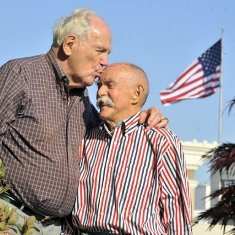
But, when marriage equality because legal—for a short time—in California, John Darby and Jack Bird knew they had to get married. They ran down to City Hall, but found it 'an absolute zoo' so they raced across the bridge to Marin County to get their marriage license. They wed in San Francisco in 2008. A friend made their wave-design wedding rings, and, after nearly fifty-years together, they ate a cake with two male figures on the top.
"I will always remember putting this on his finger. It was a marvelous day. It is so important to realize that gay life is so much more than just sex; it is love. It would be lovely if we could die together, just go to sleep holding hands and let relatives get rid of everything for us."—John Darby
When they were finally allowed to marry, John and Jack were back in San Francisco, living in an apartment in San Francisco Towers, an Episcopal residential care facility for seniors. They got quite the surprise when news of their wedding spread.
"What was really amazing was two days later there was a bag hanging on our door with a bottle of champagne and a card from an elderly widow who I thought didn't even know what the word 'gay' meant. [Another] group of residents had a big dinner party to congratulate us," Darby said. "There were some people who never spoke to us again. What do you expect?"—John Darby
The funny thing is that when John and Jack into the Towers in 1998, they were told two men couldn't share a single-bedroom apartment, so they got a two-bedroom unit and used the second to maintain a facade and a home office. Today, a photo of the couple is used in promotional material for the Towers.
Darby laughs, recalling the times he’s been asked who is the husband and who is the wife in the relationship.
"Asking a gay couple which one is the wife is like asking chopsticks which is the fork. We just work together. We went from being friends to dating; became partners and became spouses. Not husband and wife."—John Darby
For fifty-four years, five of them as Husband and Husband.
Happy early anniversary John and Jack.

Subscribe to:
Posts (Atom)


